

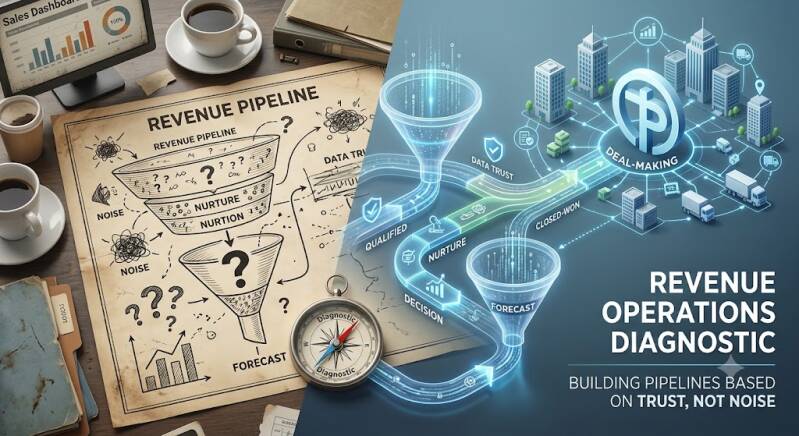
The Revenue Operations Diagnostic I Run on Every New Client in Week 1
By Mohamed Elgazar | MG Business Solutions | mgbusinesssolutions.ca
When I take on a new client, the first thing I do is not open a slide deck or propose a strategy. I run a diagnostic.
Five questions. One conversation. Thirty minutes. The answers tell me more about a company's revenue health than any financial report, sales dashboard, or team org chart ever could.
I developed this diagnostic over 14 years running Revenue Operations at Vodafone Egypt, one of the world's largest mobile operators, where I managed commercial systems across 105 offices and 650+ channel agents using Oracle CRM and Siebel. I've refined it further through seven market entry engagements at MG Business Solutions with clients across Canada and the MENA region.
The pattern I keep seeing? The gap between what leadership believes is happening in their revenue pipeline and what is actually happening is almost always wider than anyone expects.
This diagnostic closes that gap. Fast.
Question 1: What does your CRM actually reflect — and what does your team believe that isn't in it?
This is where most revenue operations problems are hiding.
At Vodafone Egypt, when I first inherited the Oracle CRM and Siebel systems, I discovered that a significant percentage of pipeline data was either outdated, manually overridden, or simply not logged by field agents. The system had information in it. The real pipeline lived in people's heads and spreadsheets.
We spent months building CRM governance protocols, mandatory data entry standards, audit trails, and activity tracking rules across all 105 offices. The result was a 30% improvement in reporting accuracy and a 30% increase in decision velocity. Not because we bought new software. Because we made the existing system reflect reality.
What to look for: Ask three of your sales reps to pull the pipeline in your CRM right now. Then ask them what they actually think is likely to close. If the two answers are different — and they almost always are — you have a data integrity problem, not a sales problem.
Question 2: How does a lead become a forecast? Who decides, and when?
In most small and mid-sized companies I work with in Canada, forecasting happens in someone's head. A senior leader makes a call based on feel, experience, and whoever shouted the loudest in the last pipeline meeting.
This is not forecasting. This is informed guessing.
At Vodafone Egypt, I built Excel-based forecasting models that incorporated competitive analysis, historical activation data, seasonal patterns, and channel-level inputs from across the distribution network. The output was a product-based sales target framework that sales managers could actually use to plan not just report against.
The result: a consistent 3.5% annual increase in gross activation share, sustained over multiple years, with target achievement consistently running at 105–107%.
What to look for: Can you trace how a specific deal enters your forecast? Is there a defined stage, a threshold, a set of criteria? Or does a deal just "feel" forecastable when someone decides it does? The answer tells you exactly how much confidence you can place in your revenue projections.
Question 3: What is your actual sales cycle length — and when did you last measure it?
Most companies quote their average sales cycle as the number they tell investors. The actual number — from first meaningful contact to signed contract — is almost always longer, and varies wildly by segment, channel, and deal size.
At MG Business Solutions, I've worked with clients entering new markets — including Canadian market entry for MENA exporters — where assumed sales cycles were off by 40–60%. The assumptions were built on experience in a different market, with different buyers, different trust dynamics, and different procurement timelines.
What to look for: Pull your closed-won deals from the past 12 months. Calculate actual time from the first touchpoint to close by deal size and segment. Compare to what your team quotes when asked. The difference is your planning risk.
Question 4: Which of your KPIs actually changes decisions — and which ones just live in a report?
This is the question that makes revenue operations uncomfortable — because the honest answer is usually that most KPIs are decorative.
At Vodafone Egypt, I defined KPIs for all sales channels and built dashboards and campaign reporting systems that increased team efficiency by 10%. But that only happened after we ruthlessly cut the metrics that nobody was using to make decisions. The initial dashboard had over 40 metrics. The one that actually drove the behaviour had seven.
What to look for: In your next leadership meeting, when someone references a KPI, ask: "What would we do differently if that number were 20% higher? What would we do differently if it were 20% lower?" If the answer is "nothing," — that metric is noise.
Question 5: If your top sales rep left tomorrow, how much pipeline risk would you discover next week?
At Vodafone Egypt, I managed partner due diligence and contract optimization across 650+ channel agents. One core principle: no single agent, no single region, no single product line could carry an outsized revenue share without a documented succession and risk plan.
The result was C$10M in annual partner cost savings through systematic contract optimization — and a distribution network resilient to personnel changes.
What to look for: Ask your CRM to show the pipeline by owner. If one or two people carry more than 40% of the active pipeline, you have a concentration risk that isn't visible anywhere in your financials — until the day it is.
What Happens After the Diagnostic
Most companies don't have a sales problem. They have an operations problem showing up as a sales problem. CRM data that doesn't reflect reality. Forecasts built on gut feel. Sales cycles longer than anyone admits. KPIs nobody uses to decide anything. Pipeline concentrated in a handful of people.
Fix the operations. The revenue follows.
At MG Business Solutions, this diagnostic is the starting point for every commercial strategy, GTM engagement, and RevOps advisory we deliver. If you want to run it on your own business, I'm happy to do it with you. Book meeting Email
DISCLAIMER
The information in this article is provided for general informational and educational purposes only. It does not constitute legal, financial, tax, insurance, or professional business advice. Market data, statistics, and industry references reflect publicly available information at the time of writing and may not reflect current conditions.
MG Business Solutions is a B2B deal-making and business connector firm. We facilitate commercial introductions and partnerships. We are not licensed lawyers, accountants, financial advisors, or insurance professionals.
Always consult a qualified professional before making decisions specific to your business situation.
© MG Business Solutions | mgbusinesssolutions.ca | Oakville, Ontario, Canada
Privacy Policy · Terms of Use
Add comment
Comments