

By Mohamed Elgazar | MG Business Solutions | mgbusinesssolutions.ca | July 2026
When a sales team misses its number, the first question is almost always the wrong one.
"What's wrong with the salespeople?" Or: "Do we need to hire more reps?" Or: "Is the market soft?"
In most cases, those are not the right questions. The right question is this: do you actually have a Revenue Operations system or do you just have sales activity?
There is a significant difference. And the gap between the two is costing North American businesses more than most leadership teams realize.
I know this because I have spent the better part of three decades on both sides of it building Revenue Operations infrastructure at scale inside one of the world's largest telecom operators, and then walking into North American businesses as an outside advisor and seeing the same structural gaps, over and over, regardless of company size or sector.
The problem is not your salespeople. The problem is the system or rather, the absence of one.
What a Revenue Operations System Actually Is: Let me be precise, because this term gets used loosely.
A Revenue Operations system is not a CRM. It is not a dashboard. It is not a stack of sales tools that your team uses inconsistently.
A Revenue Operations system is the set of processes, data structures, governance rules, and feedback loops that ensure your commercial activity marketing, sales, customer success is coordinated, measurable, and improving over time. The CRM is one instrument in that system. The forecast model is another. The pipeline review cadence is another. The KPI framework is another.
Without the system, each of those instruments plays its own tune. With the system, they play together. And the financial difference between those two states is enormous.
The core distinction: Sales activity is what your team does. Revenue Operations is the system that makes that activity predictable, repeatable, and scalable. Most businesses invest heavily in the former while neglecting the latter entirely.
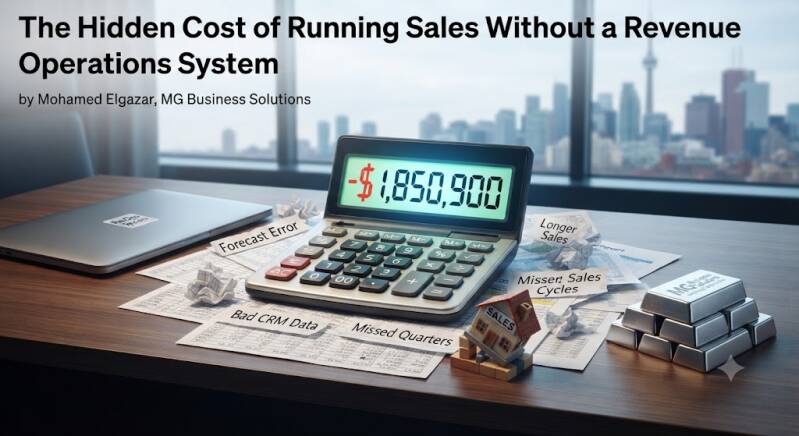
The Five Hidden Costs and What They Look Like in Practice
Cost 1: Forecast Error:
When there is no structured approach to forecasting no stage definitions, no probability weighting, no close-date discipline leaders make decisions based on gut feel and optimism. The pipeline looks healthy on paper. The quarter ends short.
At Vodafone Egypt, I built product-based sales target frameworks and forecasting models that incorporated historical activation data, competitive inputs, seasonal patterns, and channel-level performance across 105 offices and 650+ distribution agents. The result was sustained target achievement at 105–107% over multiple years. That kind of consistency is not luck. It is a system.
What this costs you: Forecast error leads to bad hiring decisions, wrong inventory positions, missed board commitments, and destroyed trust between sales leadership and the C-suite. It is the most expensive invisible line on your P&L.
Cost 2: CRM Data You Cannot Trust
Most CRM systems in North American SMBs are not a record of what is happening in the pipeline. They are a record of what sales reps chose to log, when they remembered to do it, using whatever fields made sense to them at the time.
When I inherited the Oracle CRM and Siebel systems at Vodafone Egypt, a significant portion of pipeline data was outdated, manually overridden, or simply missing. The real pipeline lived in people's heads and spreadsheets. We built data governance protocols, mandatory entry standards, audit trails, and activity tracking rules across every office. The outcome: a 30% improvement in reporting accuracy and a 30% increase in decision velocity.
What this costs you: When you cannot trust your CRM, every decision downstream is built on sand. Pipeline reviews become opinion sessions. Coaching conversations have no factual foundation. Territory planning is guesswork. The compounding cost of bad data is almost impossible to fully measure, and that is exactly the problem.
Cost 3: KPIs That No One Uses to Decide Anything
Most companies measure more than they manage. The monthly sales report has 30 metrics. Leadership reviews it. Nobody changes behaviour because of it.
Effective Revenue Operations reduces the metric set to the handful of numbers that actually change decisions. At Vodafone Egypt, I defined the KPI architecture for all sales channels and built campaign reporting systems that increased team efficiency by 10% not by measuring more, but by measuring the right things and connecting those measurements to specific management actions.
What this costs you: Decorative KPIs create the illusion of measurement without the benefit of it. You spend time in review meetings discussing numbers that do not drive any action. Worse, the metrics that actually matter the ones that predict problems before they become crises go unwatched because they are buried in the noise.
Cost 4: Revenue Concentrated in People, Not in Process
Ask most sales leaders: what happens to your pipeline if your top two reps leave next month? The honest answer reveals whether you have a Revenue Operations system or a collection of individual relationships held together by personal motivation.
At Vodafone Egypt, I managed partner due diligence and contract optimization across 650+ channel agents. One foundational principle was redundancy: no single agent or region could carry an outsized share of revenue without a documented risk and succession plan. This discipline generated C$10M in annual partner cost savings through contract optimization, and built a distribution network resilient to personnel change.
What this costs you: People-dependent revenue is fragile revenue. It does not scale. It cannot be valued accurately. And when a key person leaves — which they will — the damage is immediate and structural. The cost is not just lost deals. It is lost institutional knowledge, lost relationships, and a pipeline that was never really in your CRM to begin with.
Cost 5: Sales Cycles That Are Longer Than Anyone Admits
Every organization I have worked with quotes a sales cycle length. The number is almost always the figure that makes their model look attractive. The actual measured cycle from first meaningful contact to signed contract is consistently longer.
In my market entry engagements at MG Business Solutions helping MENA exporters enter the Canadian market and Canadian companies expand internationally, I have seen assumed sales cycles off by 40 to 60 percent. When the model is wrong, the forecast is wrong. When the forecast is wrong, the business makes wrong decisions about hiring, investment, and cash flow.
What this costs you: Systematically underestimating sales cycle length inflates pipeline value, pulls forward revenue recognition, and creates a recurring pattern of near-miss quarters. Fixing it requires measuring it, which requires a Revenue Operations system that tracks actual cycle data, not assumed data.
"Most companies don't have a sales problem. They have an operations problem that is showing up as a sales problem."
What It Takes to Fix It
The answer is not a new CRM. It is not more sales training. It is not a larger team.
The answer is building — or rebuilding — the Revenue Operations infrastructure that makes your existing talent, tools, and pipeline work the way they should.
That means establishing CRM governance so the data reflects reality. It means defining a forecasting model with explicit stage criteria and probability logic. It means identifying the five to seven KPIs that actually drive decisions and removing everything else. It means building pipeline coverage and redundancy into the system so that no single person carries unquantified risk.
At MG Business Solutions, this is the work we do. With clients entering new markets, scaling commercial teams, or trying to understand why their pipeline looks healthy and their quarters keep coming in short, we start with the operations. The revenue follows.
The diagnostic question: If your top two salespeople left tomorrow, how long would it take your pipeline to collapse? The answer tells you almost everything you need to know about whether you have a Revenue Operations system or a collection of individual efforts.
If this describes your business — or a business you know — I am happy to run a quick diagnostic conversation. No proposal. No deck. Just the five questions that tell me where the real gap is.
Ready to build a pipeline based on trust, not noise? MG Business Solutions helps Canadian businesses generate qualified opportunities through warm introductions and relationship-driven growth. Book meeting Email
DISCLAIMER
The information in this article is provided for general informational and educational purposes only. It does not constitute legal, financial, tax, insurance, or professional business advice. Market data, statistics, and industry references reflect publicly available information at the time of writing and may not reflect current conditions.
MG Business Solutions is a B2B deal-making and business connector firm. We facilitate commercial introductions and partnerships. We are not licensed lawyers, accountants, financial advisors, or insurance professionals.
Always consult a qualified professional before making decisions specific to your business situation.
© MG Business Solutions | mgbusinesssolutions.ca | Oakville, Ontario, Canada
Privacy Policy · Terms of Use
Add comment
Comments